
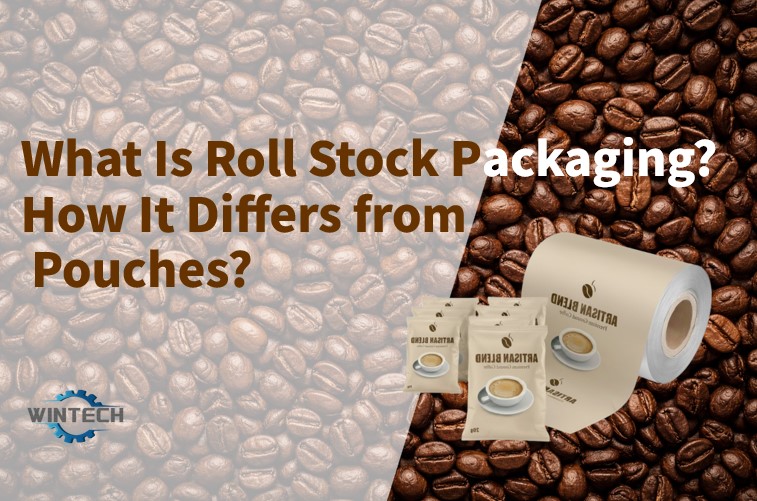
In food and pharmaceutical manufacturing, packaging is a key part of production efficiency, logistics, and brand identity. Roll stock packaging has become a popular choice for automated production lines due to its high speed, flexibility, and cost-effectiveness.
However, many businesses remain unsure about the differences between roll stock and pre-made pouches, or when to choose one over the other. This article provides a clear overview of what roll stock is, how it works, its advantages, and how it compares with pre-made pouch packaging.
What Is Roll Stock?
Roll stock refers to flexible packaging materials supplied in continuous rolls, commonly used in Form-Fill-Seal (FFS) machines. Typical materials include OPP, PET, PE laminates, aluminum foil films, high-barrier plastics, and eco-friendly PLA biodegradable films.
Roll stock can be pre-printed with brand designs and product information. The packaging machine then forms the pouch and fills the product during the same process. It is widely used in the food and pharmaceutical sectors for powders, granules, and small-dose sachets.
How Roll Stock Packaging Works
Roll stock packaging is at the heart of the Form-Fill-Seal (FFS) process, which is a fully automated process ideal for high-volume, uniform production. The process involves:
- Film feeding: Roll stock is fed into the machine’s forming system.
- Bag forming: The film is automatically folded and shaped into pouches.
- Filling: Powders or granules are dispensed into the formed pouch.
- Sealing & cutting: The pouch is heat-sealed and cut.
Advantages of Roll Stock Packaging
Roll stock packaging has become a preferred choice in food and pharmaceutical manufacturing thanks to its ability to streamline processes and reduce costs. To better understand why, here are four major advantages of using roll stock:
Lower Material Cost:
Roll stock has a lower unit cost than pre-made pouches, which is ideal for large-scale, consistent production.
High Production Efficiency:
It integrates with FFS machines for continuous packaging, reducing manual work and sealing errors.
Flexible Printing & Full-Design Coverage:
It allows for full-surface printing of logos and product information to strengthen brand identity.
Reduced Material Waste:
Automated cutting and sealing reduce edge waste and material usage.
Roll Stock vs. Pre-Made Pouches: What’s the Difference?
Roll stock is ideal for high-speed, integrated production lines, while pre-made pouches are better suited for startups, OEM brands, or low-volume pilot runs. Here are the key differences between roll stock and pre-made pouches:
- Production Process: Roll stock requires fully automated forming, filling, and sealing, whereas pre-made pouches only need semi-automatic filling and sealing.
- Cost & Efficiency: Roll stock is best for large runs with a lower unit cost. Pre-made pouches are suitable for small batches and early-stage production.
- Equipment Investment: Roll stock requires a higher equipment investment for its high capacity. Pre-made pouches require a lower investment and offer flexible operation.
- Design Flexibility: Roll stock allows for full-roll printing and a wide range of pouch formats. Pre-made pouches are limited by the bag supplier’s inventory and print setup.
Which One Should You Choose for Your Product?
The choice between rollstock and pre-made pouches ultimately depends on your product and business needs. Below, we’ll explain how to determine which option best fits your situation.
- For large batch sizes or a single product type, choose roll stock, as it is ideal for speed and consistency.
- For multiple SKUs or short-term projects, choose pre-made pouches for easy changeovers and flexible pouch types.
- For strong branding and custom pouch design, choose roll stock because it supports custom printing and pouch shapes.
- For a limited equipment budget or early production stage, choose pre-made pouches, as semi-automated systems can get you started quickly.
- If you are looking to fully automate your packaging line, choose roll stock, as it seamlessly integrates with forming and sealing machines.
(Read more: Which Types of Packaging Materials Are Best for Your Product?)
Frequently Asked Questions (FAQ)
To help you better understand what roll stock is and how it compares to other packaging options, we’ve compiled a list of frequently asked questions. These quick answers address common concerns and make it easier to choose the right packaging solution.
Q1: Do I need an FFS machine to use roll stock?
A: Yes. Roll stock is just raw material and must be paired with a form-fill-seal machine to complete the forming and sealing process. If you don’t have one, pre-made pouches are a better fit.
Q2: Which industries benefit most from roll stock?
A: Roll stock is especially suitable for the food industry and pharmaceuticals, where products require automated, high-efficiency, and consistent output.
Q3. Is roll stock packaging suitable for small businesses?
A: Roll stock packaging is usually more cost-effective for medium to large businesses because it requires investment in automated Form-Fill-Seal (FFS) equipment and higher production volumes. Small businesses may find pre-made pouches more practical, unless they work with a contract packager that already has roll stock capabilities.
Q4. Can roll stock packaging support custom printing and designs?
A: Yes. Roll stock can be fully customized with high-quality printing, allowing full-surface graphics, logos, and product information. It also supports various pouch shapes and features, making it a strong option for branding.
Q5. Is roll stock packaging eco-friendly?
A: Roll stock can be eco-friendly depending on the material used. Options such as recyclable films, biodegradable PLA, or reduced material usage from efficient cutting make it a more sustainable choice compared to many traditional packaging methods.
Our Packaging Equipment Solutions
We offer packaging machinery tailored to both roll stock and pre-made pouch applications.
- AF2100 Automatic Powder Filling Machine for Rounded Corner Pouches: Supports roll stock and multiple pouch types, and integrates forming, filling, and sealing.
- AF2000 Precision Powder Dosing Machine: Supports various containers, and is ideal for high-accuracy filling.
- SF1002 Semi-Automatic Weighing Filler: Designed for pre-made pouches and suitable for food and pharmaceutical granule products.
Conclusion
Understanding what roll stock is and how it differs from pre-made pouches can help you choose the right packaging solution for your products. Whether your priority is cost savings, production efficiency, or design flexibility, the right choice depends on your business goals and growth plans.
If you’d like tailored advice or need support finding the best packaging option, feel free to contact our team—we are here to help you choose the right packaging strategy and equipment. You can request a catalog, schedule a demo, or send us your sample bags to receive expert guidance.
Read more: